
Why Engagement Starts Before the Event, Not On the Day
Why Engagement Starts Before the Event, Not On the Day
Most event organisers think engagement is something that happens in the room. They focus on:
- Icebreakers
- Panels and Q&A
- Networking breaks
- Energy on the day
So when engagement feels flat, the instinct is to tweak the agenda.
Different speakers, more interaction, better facilitation.
But this misses the real issue. Engagement doesn’t fail on the day. It fails long before people arrive.

The real mistake: expecting momentum to appear at the venue
When people walk into an event cold, they behave predictably. They:
- Listen politely
- Talk to people they already know
- Stay surface-level
- Leave without clear next steps
That’s not a personality problem. It’s a design problem.
You cannot compress trust, relevance, and intent into a few hours and expect depth.
Engagement needs context.
Context takes time.
Events don’t create engagement. Systems do.
Engagement is not a vibe you generate in the room. It’s the result of:
- Shared expectations
- Familiarity
- Aligned intent
- A sense of “why this matters”
When none of that exists before the event, the room has to start from zero.
And zero is expensive.
A familiar organiser scenario
An organiser promotes an event well.
Registrations are strong, speakers are confirmed, sponsors are on board. But on the day:
- People arrive late
- Conversations stay generic
- Interaction feels forced
- Sponsors struggle to engage meaningfully
Afterwards, the feedback is vague:
“Great speakers.”
“Nice atmosphere.”
But nothing actually moves. Not because the event wasn’t good, but because engagement was expected to magically appear.
How to do better on Sixth Hive
Sixth Hive allows organisers to design engagement before the event exists physically.
Instead of waiting for the day, you can activate:
- Pre-event groups where attendees gather early
- Pre-event conversations around themes, questions, and intent
- Early signals about who’s attending and why
- Sponsor presence inside relevant discussions, not just on stage
This changes attendee behaviour. When people arrive:
- They already recognise names
- They already share context
- They already have reasons to talk
The room feels warmer, faster. Sponsors benefit too. They are no longer interrupting attention.
They are participating in existing conversations.
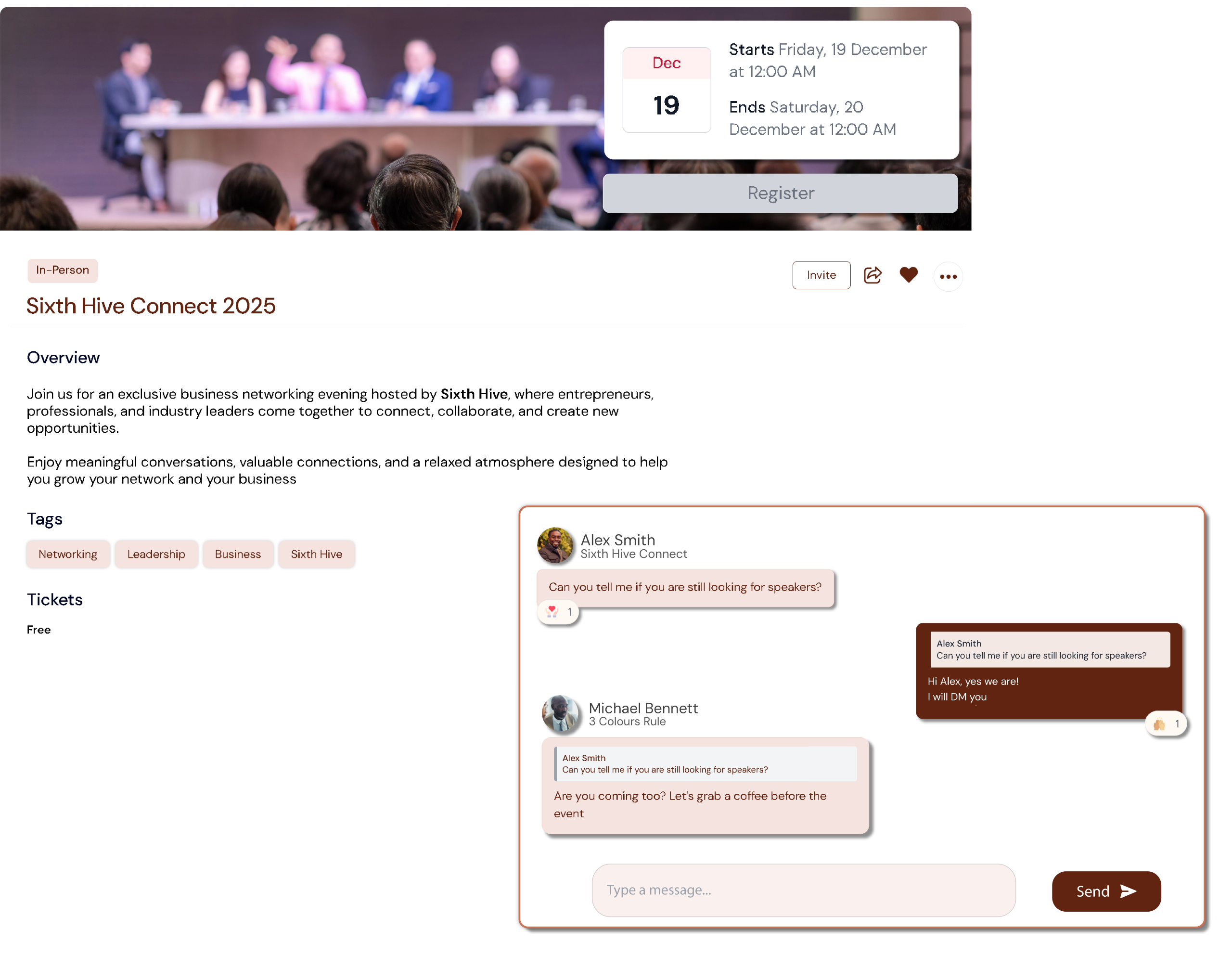
What changes when engagement starts early
When engagement is activated before the event:
- Participation increases naturally
- Conversations deepen faster
- On-the-day facilitation becomes easier
- Sponsors see clearer value
- Outcomes feel intentional, not forced
The event stops being a cold start.
It becomes a continuation.
Why this matters commercially
For organisers, pre-event engagement changes the economics. It:
- Increases perceived value
- Strengthens sponsor propositions
- Reduces reliance on one-day performance
- Makes events repeatable, not exhausting
You’re no longer reinventing engagement every time.
You’re building momentum.
Activate engagement before your next event
If you want people to engage on the day, give them a reason to engage beforehand.
Do this now
- Create a pre-event group where interested attendees can gather
- Seed conversations around the event’s purpose and themes
- Invite sponsors into context-driven discussions, not just visibility slots
Stop doing this
- Waiting until the event starts to “warm up” the room
- Treating engagement as facilitation only
- Expecting energy to replace structure
Expect this
- More natural interaction on the day
- Stronger sponsor participation
- Events that feel alive before they begin
Engagement doesn’t start when the first speaker talks.
It starts when people know why they’re showing up.
Recent posts

Why I built Sixth Hive
Why I built Sixth HiveI have spent my career watching brilliant people miss each other. I could not keep accepting

AI-Powered Business Opportunity Platform
The AI-powered business opportunity platformNetworking without the noise. The right people, partners, and opportunities, found for you. Why do we

