
Why the Real ROI of an Event Is What Happens After It Ends
Why the Real ROI of an Event Is What Happens After It Ends
Most events are judged by what happens on the day.
- Attendance.
- Energy in the room.
- Speaker feedback.
- Photos and posts.
Then the doors close and the value evaporates. Follow-ups are sporadic, conversations fade, and sponsors disappear until the next pitch.
If this feels familiar, it’s not because your event failed.
It’s because the event was treated as the end point, not the starting point.

The real problem: events are built to peak, not compound
Most events are designed to climax. Everything is optimised for:
- The agenda
- The speakers
- The moment
Once the moment passes, there’s no structure to carry value forward. So outcomes depend on:
- Individual initiative
- Memory
- Energy
- Luck
That’s not a system. That’s leakage.
ROI disappears not because people weren’t interested, but because nothing existed to hold attention in place
Events don’t fail. Follow-through does.
Events create density:
- People with shared interests
- Overlapping intent
- Fresh context
But without a mechanism to extend it, density collapses immediately. People leave thinking:
“We should continue this.”
And then they don’t.
Not because they don’t want to, but because there’s nowhere obvious to go next.
A familiar organiser scenario
An organiser runs a strong event.
The audience is engaged, sponsors are pleased, the conversations are real.
The next week, the organiser sends a thank-you email. And then:
- Attendees return to their routines
- Sponsors lose visibility
- No shared space exists to continue conversations
- The organiser starts from zero for the next event
The event felt successful.
But nothing compounded.
How to do better on Sixth Hive
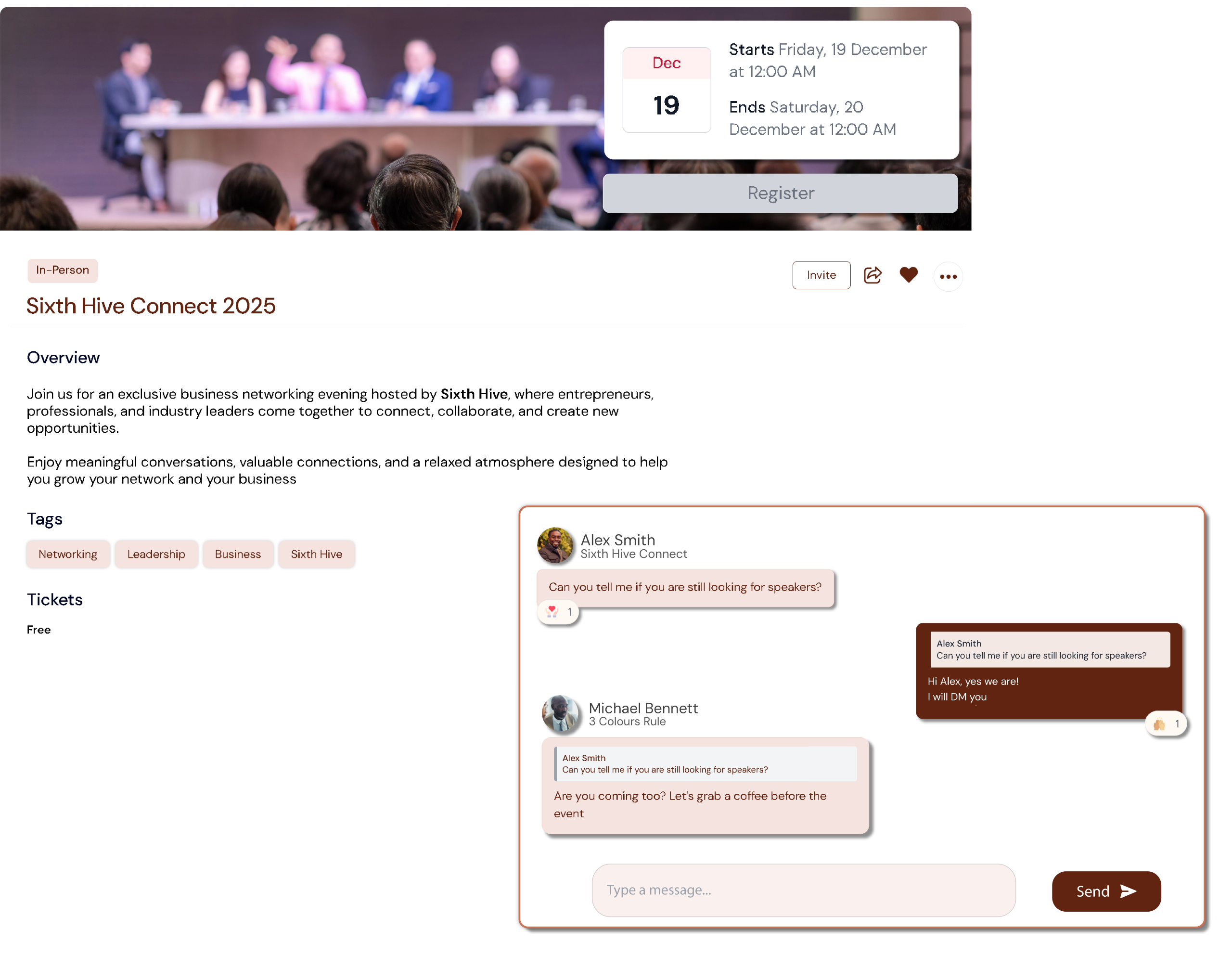
Sixth Hive is designed to extend events beyond the date.
On the platform, events don’t end; they transition. After the event:
- Conversations continue in the same context
- Connections form with shared reference points
- Content, insights, and follow-ups live in one place
- Sponsors remain visible inside ongoing engagement, not just during the event
This is where events stop being expenses and start becoming assets. Instead of asking:
“Did the event go well?”
Organisers can ask:
“What is still moving because this event happened?”
That’s the real measure of ROI.
Why this changes the organiser–sponsor relationship
Sponsors don’t want one-day exposure. They want:
- Sustained visibility
- Ongoing relevance
- Contextual engagement
- Evidence of continued attention
When events are extended through Sixth Hive:
- Sponsors stay present in conversations
- Value is visible over time
- Partnerships feel strategic, not transactional
This makes sponsorship easier to renew, and easier to justify.
What changes when events are designed to compound
When post-event leverage is intentional:
- Momentum continues instead of dropping
- Relationships deepen naturally
- The next event becomes easier to sell
- The organiser’s role shifts from host to connector
The event becomes part of a living ecosystem, not a calendar entry.
Turn your next event into a compounding asset
If nothing happens after your event, that’s where the real loss is.
Do this now
- Keep event conversations alive in a shared space
- Encourage post-event connections and follow-ups in context
- Extend sponsor visibility beyond the event date
Stop doing this
- Treating the event as the finish line
- Letting conversations scatter across inboxes
- Resetting to zero for every new event
Expect this
- Stronger long-term engagement
- Clearer sponsor ROI
- Events that build on each other instead of burning out
The most valuable part of an event isn’t the moment everyone remembers.
It’s what continues because the event happened.
Recent posts

Why Engagement Starts Before the Event, Not On the Day
Why Engagement Starts Before the Event, Not On the Day Most event organisers think engagement is something that happens in

Why Most Events Attract People But Not Sponsors
Why Most Events Attract People But Not Sponsors Many events look successful on the surface. Tickets sell. The room is

