How Shared Spaces Create Faster Trust
How Shared Spaces Create Faster Trust
Trust is the invisible currency of every community.
Without it:
- Participation stays cautious
- Conversations remain surface-level
- Collaboration never quite starts
With it:
- People speak sooner
- Ideas move faster
- Opportunity forms naturally
The mistake most organisers make is assuming trust will emerge over time. It won’t, unless the space is designed to support it.

Trust doesn’t scale through introductions
Many communities rely on familiar rituals:
- Welcome posts
- Icebreaker threads
- Casual check-ins
These create friendliness, not trust. Trust forms when people can:
- Observe how others think
- Engage around shared context
- Contribute without reintroducing themselves every time
Introductions tell you who someone is.
Shared spaces show you how they operate.
That’s the difference.
The real problem: conversations are scattered
In most communities, interaction is fragmented. People talk:
- In comments
- In private messages
- In side chats
- In one-off threads
Nothing accumulates. So every interaction starts from zero.
People don’t build confidence because there’s no continuity.
Organisers don’t see momentum because it’s invisible.
Trust struggles to form because context keeps resetting.
A familiar organiser scenario
A group has active members.
People comment occasionally. Some conversations go deep, briefly.
Then they disappear.
New members arrive and ask the same questions.
Experienced members repeat themselves or disengage.
The organiser feels like they’re constantly restarting the engine.
Not because people don’t care, but because the space doesn’t hold the conversation.
How to do better on Sixth Hive
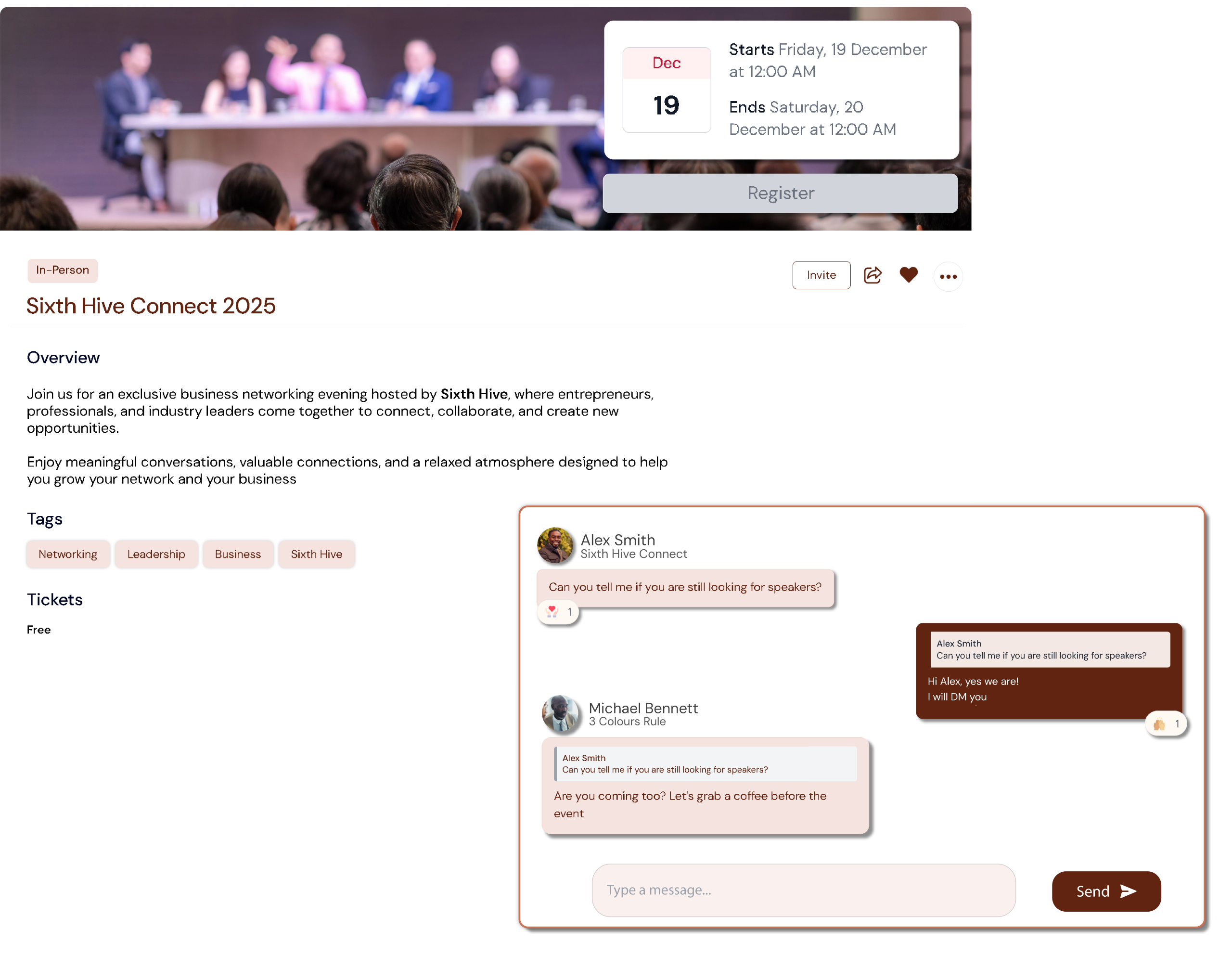
Sixth Hive is built around shared spaces, not scattered interaction.
Groups on the platform are designed so:
- Conversations live in one place
- Context accumulates over time
- Contributions remain visible and referenceable
- Members can engage without starting from scratch
When discussions are activated intentionally:
- Trust builds through repeated exposure
- Recognition forms naturally
- People feel safer contributing earlier
This is why activating group discussions matters.
It’s not about volume. It’s about creating a shared environment where:
- Thought is visible
- Context is retained
- Participation compounds
Trust accelerates because people don’t have to guess who’s who.
They can see it.

What changes when trust is designed
When shared spaces are activated properly:
- Members engage sooner and more confidently
- Conversations deepen without constant prompting
- Organisers stop acting as facilitators
- The group begins to self-regulate and grow
Trust stops being fragile. It becomes structural.
Activate shared spaces on Sixth Hive
If you want trust to form faster, give it somewhere to live.
Do this now
- Activate group discussions with clear focus and continuity
- Encourage members to build on existing conversations
- Keep interaction in shared spaces instead of scattered channels
Stop doing this
- Letting conversations fragment
- Treating trust as something that “takes time”
- Resetting context with every interaction
Expect this
- Faster trust-building
- More confident participation
- Communities that feel cohesive, not fragile
Trust doesn’t come from time alone.
It comes from shared space, shared context, and repeated interaction.
Design those, and communities start to work.
Recent posts

Participation Is the New Visibility
Participation Is the New Visibility Most communities reward the wrong thing. They reward: Being present Being seen Being loud Being

Why Communities Fail Without Direction
Why Communities Fail Without Direction Most communities don’t fail because people don’t care. They fail because no one knows why